Context Is Not Cognition

Giving an agent access to your enterprise does not make it enterprise-ready. It also needs institutional memory and governance that the enterprise owns.
TL;DR
AI providers are making agents more capable. Accountability across the enterprise takes more than any single agent provides, and that part has to be yours.
- Capable agents are arriving fast. Microsoft, OpenAI, and xAI now give agents their own workspaces and approval rules, and Meta has announced its enterprise platform.
- Those controls are built for each provider's agents. Enterprises need to verify their ability to inspect, govern, export, and retain memory, policies, and records across providers.
- That is the AI Cognition Gap: the distance between what agents can do and what an enterprise can confidently allow.
- Enterprise Cognition closes it. Knowledge, memory, and governance that the enterprise owns turn capable agents into accountable digital workers.
Agents can now do more: AI providers give them context, workspaces, and memory
Agents need to know your business, and AI providers now compete to supply that, from Microsoft's Work IQ, now rolling out across Dynamics 365 and Power Platform data, to Anthropic's Claude Marketplace with more than 2,000 connectors. Since August, several labs have also given agents their own workspaces and set them running around the clock.
Agents can now do more. Enterprises can allow more only when they can control it and prove it.
More capable does not mean more accountable
Eventually a board member, risk officer, auditor, or regulator will ask: What did the agent do, why did it do it, what policy governed the action, and who approved the outcome?
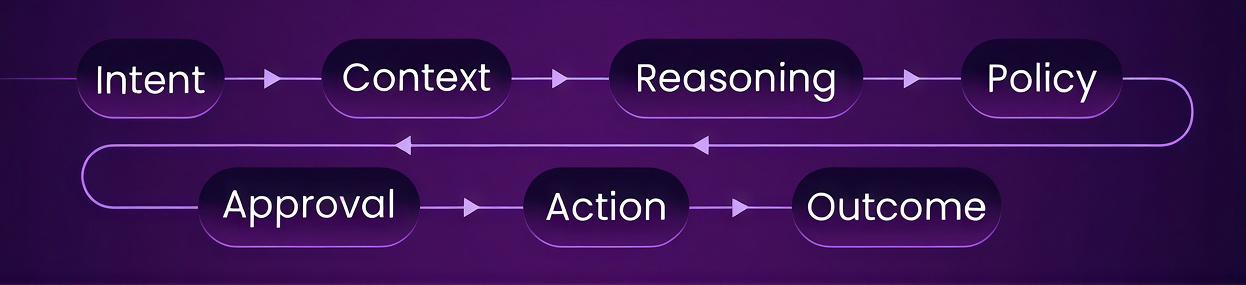
A connector can tell an agent a policyholder's coverage limit. It cannot tell the enterprise what the agent did with it. Logs and observability tools can answer parts of the question. The harder task is linking intent, context, policy, approval, and outcome into one chain.
An example: an insurance claims agent after a storm
Context gives the agent the claim file, the policy documents, adjuster notes, weather data, and repair estimates. Acting responsibly takes more. The agent must remember earlier claims and prior contact with the policyholder, determine which coverage terms, exclusions, and regulatory requirements apply, reason about the right next step, obtain approval where claims-authority limits require it, and preserve the rationale and outcome.
That step, from holding information to being accountable for an outcome, is where the gap opens.
Analysts see the same pressure. Gartner's predictions point to governance as the failure point for agents:
40% of enterprises will demote or decommission autonomous AI agents by 2027 because of governance gaps found after production incidents. Gartner prediction, May 2026
50%of AI agent deployment failures will trace to insufficient runtime enforcement in AI governance platforms by 2030. Gartner prediction, March 2026
That is the case for governing decisions at execution, not after the fact.
The platforms' controls are real, and each is built for its own agents
Microsoft routes Autopilot through Agent 365, which provides permissions and audit records. OpenAI gives dots user-set approval rules, and its specialist dots carry their own identity and credentials in pilots. xAI gives Enterprise admins access, network, and audit controls, plus team-wide rules for which actions ask first and which run automatically.
These are real controls, and they will keep improving. They are designed first for each provider's own agents. An enterprise that runs agents from several providers has to connect and govern them deliberately.
What enterprises still need to verify: memory, policy, and the record
Agents now remember. That retires an old argument and opens a harder one: whose memory is it?
OpenAI's dots keep a memory fed from the user's ChatGPT memory, and conversations with a dot feed back into it. Autopilot keeps its memory inside the customer's Microsoft 365 environment. Agent-specific memory can fragment institutional learning unless it is deliberately connected and governed.
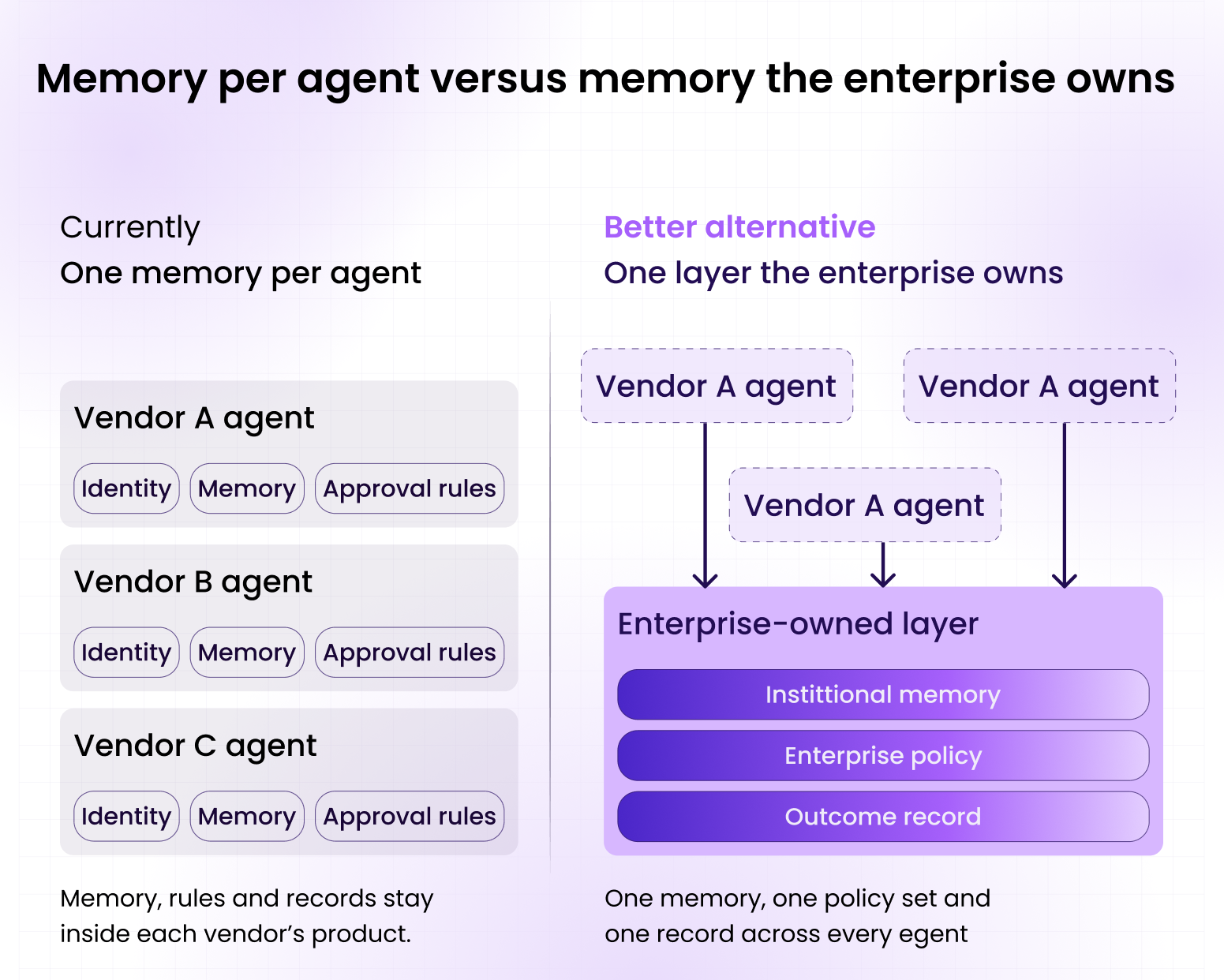
Four things to verify:
- Memory scope. Institutional memory is memory of work: what the enterprise figured out, tried, and learned. It should serve every authorized agent and person, not one user or one product.
- Visibility and exit. One analysis of OpenAI's help documentation reports that the memories of an individual dot cannot currently be viewed or edited. An enterprise needs to inspect what its agents know. Institutional memory should be inspectable, and it should survive the agent, the plan, and the provider.
- Policy. Approval and access controls are essential. Enterprises must also verify that domain-specific business rules, such as coverage terms, claims-authority limits, and data residency, are enforced.
- The record. Each provider records its own agents' actions in its own tools. OpenAI is working with Microsoft to bring specialist dots into Agent 365. That integration is not yet available, but it points to records consolidating inside one provider's control plane. In our view, the enterprise should hold the record itself.
Any agent can have an identity. The enterprise still has to govern the memory, the policy, and the record.
The AI Cognition Gap: what agents can do versus what enterprises can allow
The AI Cognition Gap is the gap between what an AI agent is technically capable of doing and what an enterprise can confidently allow it to do.
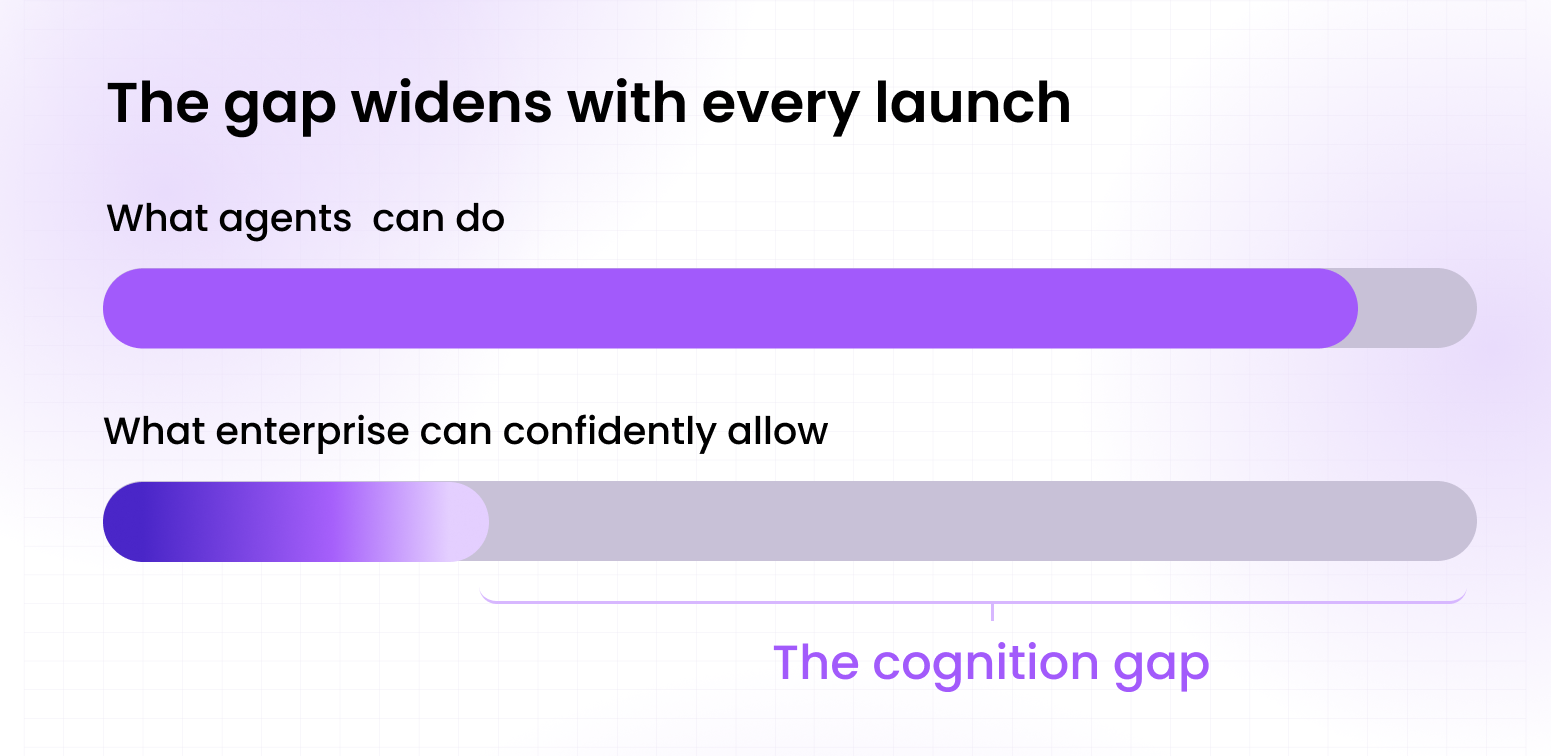
The gap is not about intelligence. It is about control and proof. Closing it takes more than context.
An enterprise-owned layer turns capable agents into accountable digital workers
Enterprise Cognition is the enterprise-owned layer of knowledge, memory, and governance that sits beneath your digital workers and the third-party agents you integrate with it. It lets an AI system understand its context, retain what the organization has learned, reason within its constraints, and account for what it did. This is the layer that makes agents accountable inside the enterprise.
A capable agent can complete a task. An accountable digital worker completes it inside policy, learns from it, and leaves evidence the enterprise owns. Capable agents are not accountable digital workers. The layer beneath them makes the difference.
Knowledge
Without it, agents act without understanding the business.
Knowledge Mesh maps your data, processes, decisions, and outcomes into one queryable intelligence stream. It resolves inconsistent records across source systems into single, authoritative business entities.
Memory
Without it, each agent learns alone and mistakes repeat at scale.
Cortex Engine holds institutional memory, the memory of work, not conversations. It reasons over that memory to refine tasks and select the right data and tools. It belongs to the enterprise, survives every departure, and enterprises can inspect, edit, and export it.
Governance
Without it, no one can prove what an agent did.
Policy-as-code checks each action at execution. Outcome Ledger records every decision, from intent to outcome, with the context and policies behind it.
Enterprise Cognition is additive. It works with the models, data, and workflows you already use, and it integrates with third-party agents as well as digital workers built on NeoSapients. Platform progress makes it more necessary, not less. Better context and always-on agents make agents more capable. More capable agents need more accountability, and the enterprise has to own it.
Five questions that test whether your platform closes the gap
Use these in your next evaluation. They apply to every provider, including us.
- Can you reconstruct an outcome? Ask the provider to show the full chain, for an agent's real action.
- When do policies run? Execution-time controls can block or constrain actions before they occur. Post-hoc controls can only identify problems afterward.
- Whose memory is it, and what happens when the agent goes away? Institutional memory should belong to the enterprise and survive the agent, the plan, and the provider.
- Where does cognition happen? Which data leaves your environment? Where are memories stored? Where are policies enforced? Who owns the resulting institutional knowledge?
- Can you swap models and agents? Avoid lock-in to a single provider's roadmap, and ask whether policy and the record cover agents from other providers.
The platforms will keep making agents more capable. Enterprise Cognition makes them accountable.